


Home solar energy generation
Understanding rooftop solar and grid export
A guide for finance directors on how domestic solar installations and the Smart Export Guarantee function within the UK energy market.
 Alex RamsayChief Commercial Officer
5 min readUpdated
What matters here
- Domestic solar generates power for on-site use and grid export.
- The Smart Export Guarantee compensates households for exported energy.
- System performance relies on MCS certification and smart meter integration.
In short
The Smart Export Guarantee is a government-backed scheme that pays households for renewable electricity exported to the grid. To access these payments, you need an MCS-certified installation, a smart meter, and a specific export tariff from an energy supplier. Payments are not automatic, so households must register with an eligible supplier to begin receiving export credits.
For finance directors and residential asset managers, understanding this mechanism is essential for calculating the true internal rate of return on renewable assets. The scheme relies on the voluntary participation of energy suppliers, meaning the market for export tariffs is competitive and requires periodic review to ensure the chosen rate remains optimal for the specific generation profile of the property.
The mechanism of domestic energy generation
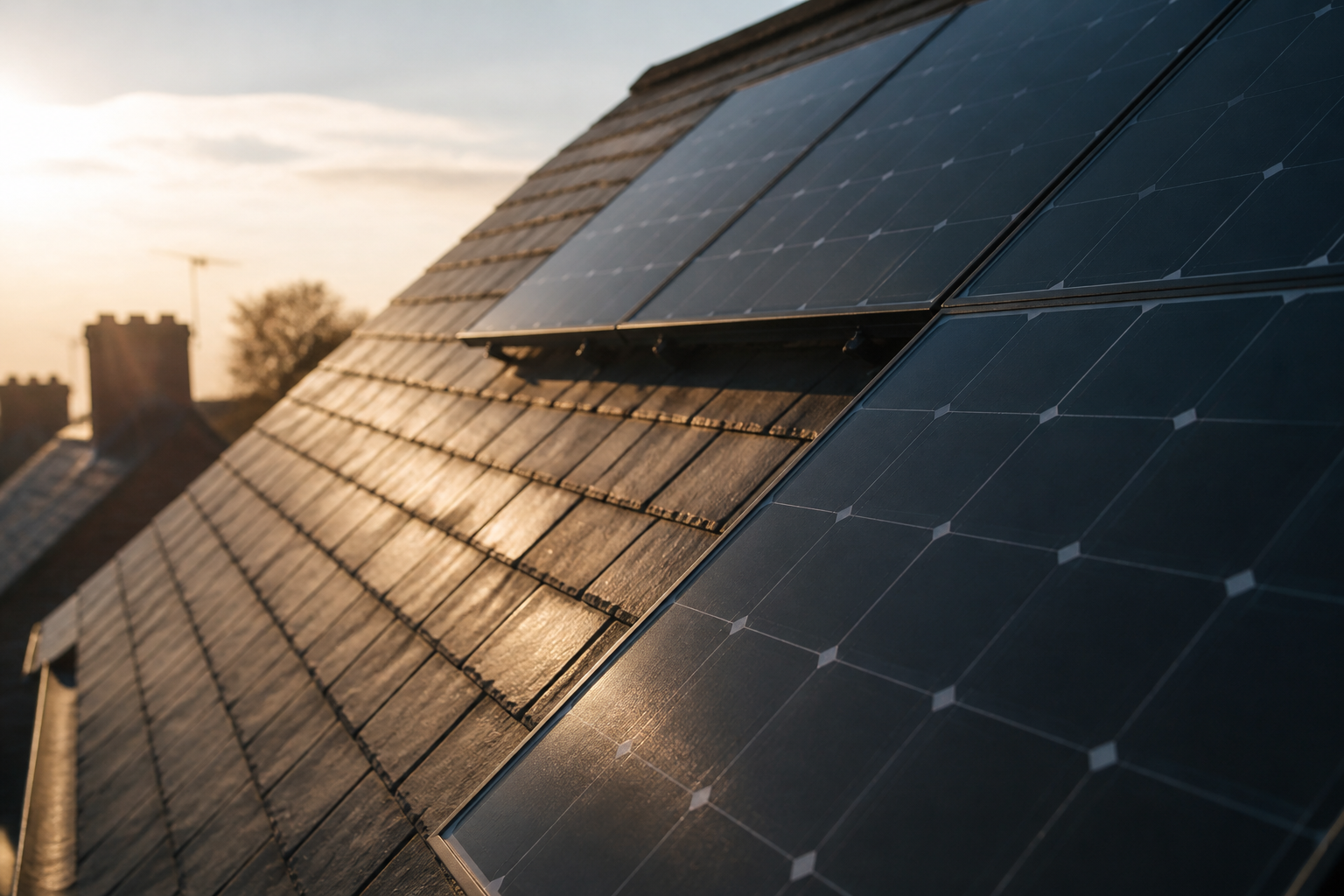
Rooftop solar panels function by converting sunlight directly into electricity. This process typically provides power to the property first, covering essential loads like lighting, appliances, or charging an electric vehicle through The Charge Scheme. When the system produces more electricity than the property requires, the excess is sent to the local grid.
To manage this two-way flow, properties require an inverter to convert the direct current generated by panels into alternating current compatible with the grid. The integration of this technology is central to The Solar Scheme. Financial controllers should note that system efficiency depends on alignment, roof quality, and the presence of smart metering to track both import and export volumes.
Technical performance is heavily influenced by the pitch and orientation of the mounting array. South-facing roofs typically generate the highest output in the UK, but east-west configurations can provide a more consistent energy profile throughout the day. Investors should consider that the inverter is the component most prone to failure; modern units often have a lifespan of 10 to 15 years, meaning a replacement cost should be provisioned within the long-term financial model of the property.
Qualifying for export payments
The Smart Export Guarantee ensures that households with small-scale low-carbon electricity generation are paid for the energy they export to the national grid. According to the Energy Saving Trust, these payments are not automatic. Homeowners must actively sign up for a tariff with a participating energy supplier.
Eligibility rests on three requirements: the system must be MCS certified, the property must have a smart meter to record exports, and the homeowner must hold an eligible export tariff. Suppliers are regulated and required to provide export terms, but rates and conditions vary between providers. It is essential to check if the export tariff is compatible with any existing battery storage systems.
The verification process often requires the submission of a Microgeneration Certification Scheme certificate, which proves the installation was completed by a qualified installer to the required safety standards. Without this documentation, suppliers are prohibited from offering export payments. It is also common for suppliers to require a G98 or G99 connection notification, which ensures the Distribution Network Operator is aware of the potential power influx, a process detailed further in Grid connection stages for home energy projects.
| Requirement | Purpose | Status |
|---|---|---|
| MCS certification | Quality assurance | Mandatory |
| Smart meter | Data measurement | Mandatory |
| Export tariff | Financial payout | Mandatory |
| Grid connection | Energy export | Mandatory |
Based on guidance from the Energy Saving Trust, 2026.
Market trends and installation records
The UK market has experienced a surge in demand for solar technology. Government data released by GOV.UK confirms that nearly 172,000 installations occurred in the first eight months of 2026 alone. This indicates that rooftop solar has become a primary choice for household energy independence, accounting for over 70 percent of all installations in July 2026.
This increase is supported by a growing range of products, including plug-in solar panels now legal across Great Britain. Retailers are expanding their offerings, which reduces the complexity of installation for many families. However, the regulatory requirements for grid connection remain strict to ensure the stability of the distribution network.
Rooftop solar is helping to drive the surge, accounting for more than 7 in 10 installations during July. This rapid growth suggests a maturing market where installation costs are increasingly offset by rising grid electricity prices, making self-generation an attractive hedge against future energy price volatility for residential portfolios.
Rooftop solar is helping to drive the surge, accounting for more than 7 in 10 installations during July.

Technical risks for property owners
Finance directors should be aware of the operational risks inherent in micro-generation. Poorly installed systems may not meet the MCS standards required for export payments, leading to a loss of potential income. Regular maintenance is also necessary to prevent dust and debris from reducing the efficiency of the photovoltaic cells.
Compatibility between the solar system and existing household heating, such as those installed through The Heat Pump Scheme, is another factor. Optimising the load between generation and heating helps maximise the financial benefit, but requires careful configuration of smart home energy management systems.
Failures often occur when the electrical infrastructure of the home is not upgraded to accommodate the inverter output, leading to voltage fluctuations that can trip the system offline. Periodic system monitoring is advised to ensure that the generation yield matches historical estimates. If the output drops significantly, check for shading from new vegetation or mechanical faults in the string inverter before contacting our schemes for further guidance.
Managing the return on investment
The financial return of a solar installation is split between avoided energy costs and export payments. Avoided costs occur when the property uses its own generation rather than drawing from the grid. Because import prices for electricity are typically higher than export rates, maximising self-consumption provides the highest financial return.
Exporting energy is a secondary benefit. While the Smart Export Guarantee provides a consistent channel for payout, it is intended to supplement the savings made by reducing reliance on external grid supply. For further insights on how these household efficiency changes impact broader financial planning, visit our schemes.
To model the ROI accurately, one must account for the degradation rate of the solar panels, which is typically 0.5 to 0.8 percent per year. By aligning high-energy activities, such as heating or electric vehicle charging, with peak production hours, residents can significantly reduce the volume of electricity exported at lower tariff rates and increase their total savings, a strategy explored in Analysing home energy efficiency and household running costs.
| Usage type | Value driver | Priority |
|---|---|---|
| Self-consumption | Avoided grid costs | High |
| Grid export | Export tariff payments | Low |
| Battery storage | Extended usage | Medium |
Prioritisation assumes that import tariffs exceed export tariff rates.
Looking ahead at energy infrastructure
The trajectory of the UK energy market suggests a continued focus on decentralised generation. As more households adopt solar technology, the grid management systems must evolve to handle two-way power flow. This requires continued investment in grid infrastructure, a subject covered in Analysing home energy efficiency and household running costs.
The policy environment remains stable, with clear guidance provided by regulatory bodies. Ensuring that future installations remain compliant with evolving standards will be key to long-term success. Those interested in the broader impact of these transitions can view updates in our insight section.
Future-proofing is essential; as storage costs decline, the integration of residential batteries will become standard practice, allowing for load shifting that goes beyond simple self-consumption. This creates a more resilient local grid and provides the homeowner with greater control over energy costs during non-solar hours.
Questions people ask
- Can I receive export payments if I have a battery system installed?
- Yes. Most suppliers allow export payments for homes with battery storage. However, you must ensure your export tariff is compatible with your specific battery setup to avoid double-counting or metering errors. Always verify with your supplier that your meter configuration permits them to track exactly what leaves your property for the grid versus what enters your battery.
- How long does it take for export payments to start after registration?
- Once you have signed a contract with an export tariff provider, the process generally takes between four and eight weeks. The supplier will need to verify your details, confirm your MCS certification, and synchronise with your smart meter to start recording export volumes. Payments are typically issued quarterly or monthly, depending on the specific terms of your chosen export contract.
- Does the Smart Export Guarantee rate change over time?
- Yes. While some suppliers offer fixed-rate export tariffs for a set period, many offer variable rates that fluctuate according to wholesale market prices. It is important to review your contract terms regularly to ensure you are receiving the best available rate for your exported energy and to compare offerings across the market, as outlined in our insight section.
- What happens if my smart meter stops recording exports?
- If your smart meter fails to transmit data, you will likely stop receiving payments. You should contact your energy supplier immediately to troubleshoot the connection or arrange for a technical visit. Some smart meters require a software update to communicate effectively with the grid, and failing to maintain this connection prevents accurate billing for the electricity you export to the network.
Keep reading

green installer workforce standards
Finding a reliable green technology installer

electricity grid capacity management
How DNOs manage residential grid capacity

domestic heat pump technology
Debunking common myths about domestic heat pump heating

electric vehicle fleet policy
Managing financial risks of electric car fleet transition

electric vehicle market analysis
Analysing UK electric vehicle adoption numbers

electric vehicle adoption guide
Steps to choosing an electric car for personal use

electric vehicle fleet policy
Impact of updated ZEV mandate targets on fleet planning

Employee financial wellbeing
Supporting employee financial resilience

Employee reward strategy design