


domestic heat pump technology
Debunking common myths about domestic heat pump heating
We examine the practical realities of domestic heat pump performance, installation requirements, and operational costs for the modern UK household.
 Thom GrootCEO and Co-Founder
5 min readUpdated
What matters here
- Heat pumps function efficiently in well-insulated homes.
- Installation requires specific surveys for radiator sizing.
- Running costs vary based on system design and energy tariffs.
In short
Heat pumps provide reliable heating by extracting warmth from the air or ground. They are highly efficient, typically producing more energy than they consume. While installation requires careful planning regarding insulation and emitter sizes, these systems serve as a primary heating solution for many homes. Success depends on professional sizing, proper system commissioning, and managing electricity tariffs to optimise usage patterns.
To ensure a successful transition, homeowners should view the heat pump as one component of a broader energy strategy. Integrating heat pump technology with other home improvements, such as those found in our schemes, can create a more cohesive and cost-effective domestic energy environment. This systemic approach is fundamental to achieving long-term efficiency.
The efficiency myth in older properties
A common concern is that heat pumps are only effective in new-build properties. The assumption is that older homes lose heat too quickly for these systems to be viable. In practice, the primary requirement is not the age of the property, but its thermal performance.
A home with high levels of insulation and draught proofing will retain heat more effectively regardless of its age. Modern The Net Zero Home Scheme assessments look at the building fabric to determine if a heat pump is suitable. When insulation levels are insufficient, the system may need to run at higher temperatures, which can reduce overall efficiency and increase energy demand.
Owners of period properties often worry that thick stone walls or lack of cavity wall insulation will prohibit installation. While these homes present challenges, they are rarely excluded. Improving the fabric before installation, such as by upgrading loft insulation to current building standards, allows the heat pump to operate at lower flow temperatures, which directly improves the seasonal coefficient of performance.
Understanding heat pump output and radiator sizing
Another persistent myth is that heat pumps simply swap into an existing gas boiler system without further work. While this is true for some components, it is rarely true for the entire heating circuit. Heat pumps generally operate at lower flow temperatures than traditional gas boilers.
To provide sufficient warmth, the surface area of the heat emitters must often increase. This means upgrading existing radiators to larger models or installing underfloor heating. Skipping this step often results in a system that struggles to meet the required room temperature on the coldest days. Proper planning for these upgrades is a standard part of the process when finding a reliable green technology installer.
The physics of heat distribution requires that low-temperature systems compensate with greater surface area. If a radiator is undersized, the heat pump must work harder, potentially leading to increased electricity consumption. A thorough heat loss calculation should be performed room-by-room to determine the exact radiator requirements, ensuring the system can maintain the design temperature even during sustained periods of cold weather.
| System Type | Typical Flow Temperature | Requirement |
|---|---|---|
| Gas Boiler | 65-75 degrees C | Standard radiators |
| Heat Pump | 35-50 degrees C | Larger emitters |
| Underfloor Heating | 30-40 degrees C | Floor loops |
Figures are illustrative of standard design parameters used by qualified installers.
Noise levels and spatial requirements
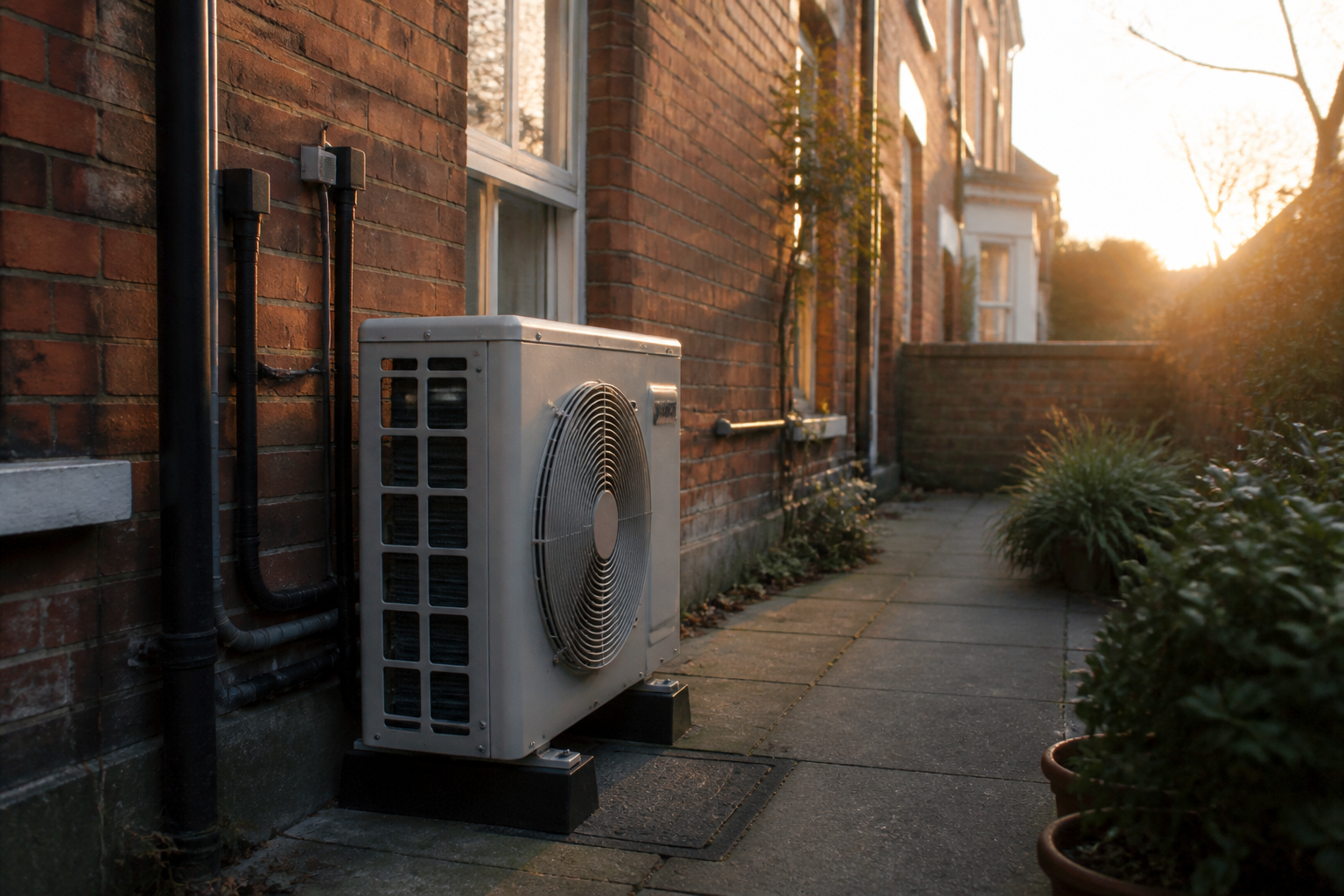
There is a widespread belief that heat pumps create significant noise pollution. While heat pumps do generate sound from their fan and compressor, modern units are designed to operate at levels comparable to a refrigerator. Most installations are compliant with permitted development rights if positioned correctly.
Strategic placement away from bedroom windows or close neighbour boundaries is a core part of the professional survey. If a site presents a challenge, installers can use acoustic baffles or specific mounting locations to mitigate the impact. Noise is rarely a barrier to installation when the site is surveyed by a qualified professional.
Placement logic also extends to the efficiency of the unit. Placing a heat pump in a shaded, poorly ventilated corner can reduce its effectiveness. Installers assess the necessary clearance around the unit to ensure optimal airflow, which is critical for extracting latent heat from the external air. This spatial consideration is as much about mechanical performance as it is about local planning compliance.
Noise is rarely a barrier to installation when the site is surveyed by a qualified professional.
The reality of winter performance
Some users fear that heat pumps stop working when the outside temperature drops below freezing. It is a fact that heat pump efficiency, measured as the Coefficient of Performance, decreases in very cold weather. However, the system does not stop functioning. It remains capable of heating the home even in sub-zero conditions.
Designers account for the coldest days of the year by sizing the system for peak load. While the efficiency might dip during a cold snap, the system is engineered to maintain target temperatures. This is a technical nuance often missed in casual discussion, but it remains a fundamental design principle for all heat pump funding and installation requirements.
It is common for systems to include a backup immersion heater, which activates only during extreme weather events. This ensures that the home stays warm, although it operates at a lower efficiency than the primary heat pump cycle. Reliable installers will model the property's heat loss using historical climate data to ensure the heat pump is sized to manage the local climate variability throughout the year.

Financial viability and energy tariffs
Financial myths often surround the cost of electricity. Because heat pumps are highly efficient, they use less energy to produce the same amount of heat as a gas boiler. However, electricity remains more expensive per unit than gas. The transition is most cost-effective when coupled with the right tariff structure.
Smart tariffs allow households to shift high-demand heating periods to off-peak hours. This can significantly reduce the running cost. Understanding the interplay between system efficiency and energy tariff strategy is essential for analysing home energy efficiency and household running costs.
Many households benefit from agile or time-of-use tariffs that align with grid demand. By using the thermal mass of the home or a well-insulated hot water cylinder to store heat during cheaper windows, the overall cost of ownership decreases significantly. This requires an active approach to energy management, but it transforms the heat pump from a fixed appliance into a flexible energy asset.
The installer capacity and quality assurance gap
A common concern is the availability of skilled installers. The market is expanding to meet demand, but quality remains the priority. Certification schemes exist to protect consumers and ensure that systems are commissioned correctly. These schemes require installers to provide evidence of training and ongoing competency.
Using certified installers also ensures that the homeowner has access to support and warranty services. When looking at our schemes for home energy, we emphasise the importance of vetting service providers. This reduces the risk of incorrect system specification and ensures long-term system reliability for the end user.
Commissioning is the final, vital step where the system is balanced and the flow rates are checked against design specifications. A system that is not commissioned correctly may fail to circulate heat properly or cause unnecessary strain on the pump. Homeowners should always request the commissioning certificate and ask for a clear walkthrough of the controller settings to ensure they can manage their heating effectively.
Questions people ask
- Can I install a heat pump in a terraced or older home?
- Yes, heat pumps are suitable for most older homes provided the property's thermal efficiency is assessed correctly. The age of the house is less important than the quality of insulation, draught proofing, and the sizing of heat emitters. Professional assessments under The Net Zero Home Scheme help identify if building fabric upgrades are required before installation.
- Will a heat pump fail to heat my home during winter?
- No, heat pumps continue to provide heat even in sub-zero temperatures. While efficiency drops slightly in extreme cold, systems are specifically sized for peak load conditions. They often include a backup immersion heater to ensure comfort on the coldest days, provided the initial design is based on accurate local heat loss calculations.
- How does the noise from a heat pump compare to other appliances?
- Modern air source heat pumps typically produce noise levels comparable to a refrigerator or dishwasher. When installed by a certified professional, they are positioned to meet planning requirements and minimise disturbance. Acoustic baffles or strategic mounting can be used to ensure the unit remains quiet and compliant with local regulations regarding nearby neighbours.
- Are heat pumps always more expensive to run than gas boilers?
- Not necessarily. Although electricity is more expensive per unit, the high efficiency of a heat pump means it requires significantly less energy to produce the same amount of heat. Running costs are optimised by using smart energy tariffs to shift heating cycles to off-peak periods, making the system highly cost-effective for well-insulated properties.
- Do I need to replace all my radiators to install a heat pump?
- Often, yes. Because heat pumps operate at lower flow temperatures than gas boilers, the system needs larger surface areas to emit the same amount of heat. Upgrading to larger radiators or installing underfloor heating is standard practice to ensure the home reaches the desired temperature efficiently, as discussed in our schemes.
Keep reading

green installer workforce standards
Finding a reliable green technology installer

electricity grid capacity management
How DNOs manage residential grid capacity

electric vehicle fleet policy
Managing financial risks of electric car fleet transition

electric vehicle market analysis
Analysing UK electric vehicle adoption numbers

electric vehicle adoption guide
Steps to choosing an electric car for personal use

electric vehicle fleet policy
Impact of updated ZEV mandate targets on fleet planning

Employee financial wellbeing
Supporting employee financial resilience

Employee reward strategy design
Implementing salary sacrifice schemes

UK climate policy research