

Green technology installer skills
Heat pump installer pathways for UK trade professionals
Understand the qualification levels and training requirements for UK heating engineers to transition into heat pump installation roles.

What matters here
- Heating engineers need a level 3 qualification to begin the transition to heat pump technology.
- The training process is structured into four levels ranging from foundation basics to expert system diagnostics.
- MCS certification is essential for installers to verify grant-funded work for residential customers.
In short
To become a qualified heat pump installer, professionals typically require a Level 3 heating or plumbing qualification as a foundation. Installers must then complete accredited training modules to master heat pump technology and system design. Achieving Microgeneration Certification Scheme (MCS) registration is necessary to sign off installations for government grant eligibility, ensuring work meets specific industry standards.
Transitioning into this sector requires more than just mechanical aptitude. It demands a rigorous understanding of low-temperature heating principles, which differ significantly from traditional high-temperature fossil fuel systems. The technical competence required ensures that every unit functions at its peak efficiency, which is essential for both homeowner satisfaction and long-term grid sustainability. As we outline in our editorial standards, transparency regarding these qualifications is the first step in successful decarbonisation.
The current demand for green heating skills
The UK heating market is undergoing a fundamental shift as technologies move away from fossil fuel boilers toward electrified heat pumps. This transition relies on a significant expansion of the skilled workforce. Data shows that the number of full-time roles dedicated to heat pump installation must grow from roughly 4,543 in 2023 to about 41,000 by 2028 to meet national objectives. This creates a clear shortfall that requires thousands of existing heating professionals to diversify their current skill sets.
For operations managers overseeing home energy projects, understanding this workforce landscape is critical. The move to greener heating is not just about the hardware but about having a certified engineer available to handle the technical requirements of the installation. Many established engineers are now proactively seeking training to ensure their practices remain relevant as technology trends move forward at a constant rate.
Our work at Net Zero Benefits involves observing how these capacity constraints affect the delivery of The Heat Pump Scheme for households. Ensuring that homeowners can connect with qualified professionals is a vital part of the supply chain. When the pool of certified engineers is small, project timelines are naturally longer, highlighting why industry-wide training is essential for long-term viability. We frequently explore these themes in our insight to help stakeholders understand how installer capacity acts as a primary bottleneck for national net zero targets.
Structured pathways for installer certification
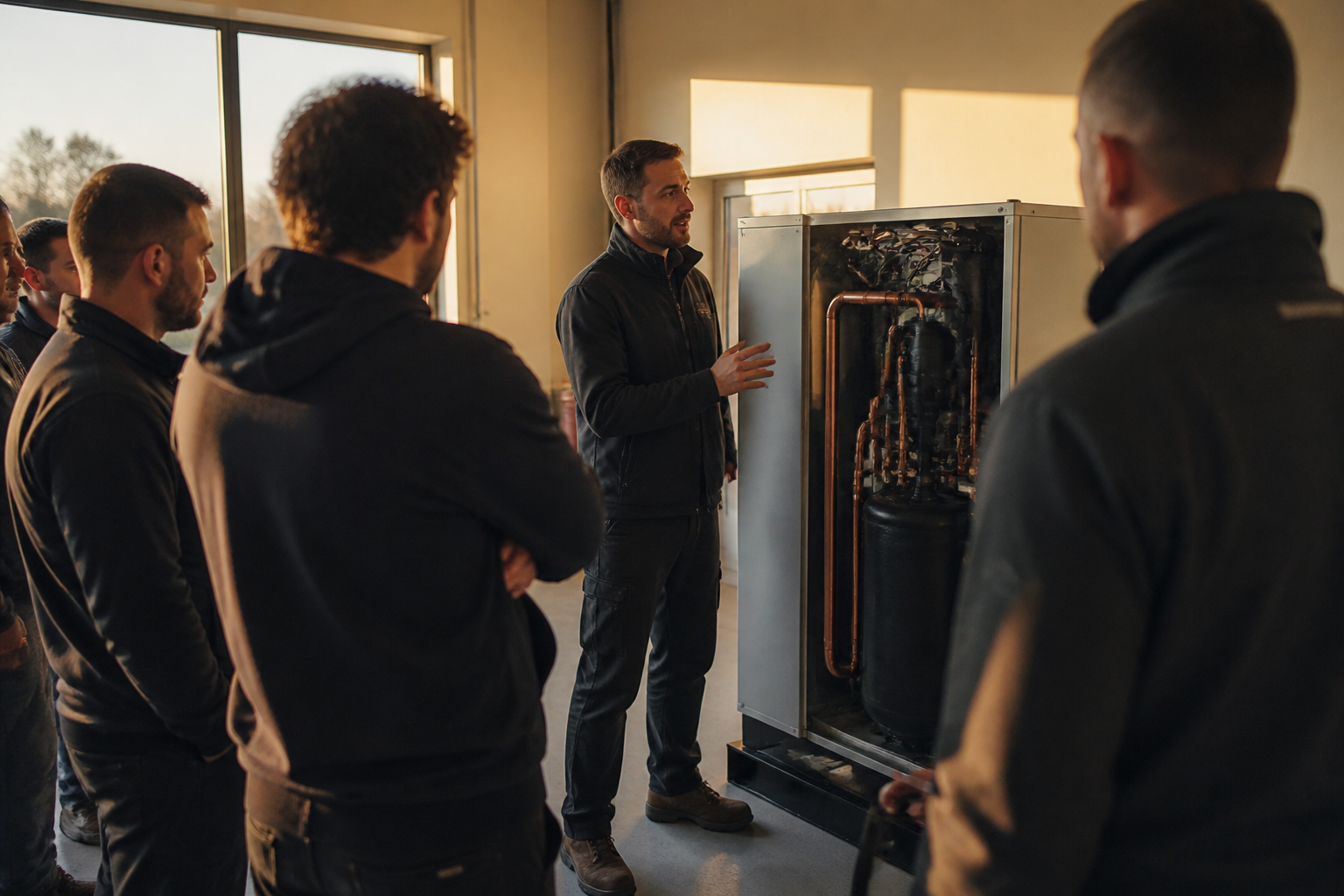
Training programmes are becoming more modular to accommodate busy working schedules. Rather than requiring engineers to take extended leave, providers now offer a step-by-step development journey. This approach allows an engineer to master foundational knowledge before moving into complex diagnostic work. The learning pathway is typically split into four distinct levels of competency.
Level 1 covers the foundation of heat pump technology and core installation best practices. Level 2 focuses on deepening installation techniques and providing support for live site work. Level 3 is the critical milestone where an engineer learns the specific requirements to become MCS registered. Finally, Level 4 focuses on advanced refrigeration circuits and system diagnostics, which is essential for becoming a fully certified expert.
This four-level progression ensures that installers build confidence at their own pace. By combining online modules with hands-on learning at dedicated academies, the industry is making it easier for traditional heating engineers to adapt their existing knowledge of plumbing and heating systems to modern heat pump applications. Successful completion of these levels often requires demonstration of heat loss calculations, which remain a primary failure point for inexperienced installers who fail to account for building fabric efficiency.
The UK heating market is evolving and it is important to stay ahead of the curve by installing electrified products.
| Level | Focus Area |
|---|---|
| 1 | Fundamentals and system basics |
| 2 | Applied installation techniques |
| 3 | MCS registration requirements |
| 4 | Refrigeration and diagnostics |
Based on the Skill Up training programme structure launched in July 2026.
The role of MCS certification
Microgeneration Certification Scheme (MCS) registration is a standard requirement for any installer signing off grant-funded work in the UK. Without this certification, an installation cannot qualify for certain government support schemes. This creates a barrier for newer installers who have the technical skill but lack the formal verification that homeowners require to access financial assistance.
To obtain certification, engineers must demonstrate competence in both design and installation. The process involves a technical assessment of their work. While some installers go through direct certification, others may use an umbrella scheme to gain the necessary credentials. This distinction is vital for those entering the trade, as it changes the timeline and administrative burden of becoming a recognised professional.
For those coordinating The Net Zero Home Scheme, verifying that an installer holds valid MCS accreditation is the most important step in the vetting process. It ensures that the project meets safety and performance standards while maintaining eligibility for necessary grants. Employers should always verify these credentials early in any project planning phase to avoid delays. Missing documentation or expired credentials are the most common reasons for failed grant applications, leading to significant disruption for the end user.
Integrating training into business operations
For firms operating in the green technology space, supporting staff or partners through these training levels is a strategic advantage. As The Charge Scheme and other electrification projects scale, the bottleneck is rarely the lack of consumer interest, but rather the lack of available hands to do the work. Companies that help their engineering partners navigate the transition to heat pump installation create more reliable, long-term delivery channels.
The shift requires an understanding that heat pump technology behaves differently than gas-fired boilers. Hydraulic balancing and heat distribution calculations are essential components of the curriculum. For an operations manager, knowing which level of training an installer has achieved provides a helpful indicator of their capability to handle complex residential upgrades versus basic unit replacements.
We often see that projects run smoother when the installer has completed the full four-level programme. This depth of knowledge means fewer follow-up visits and higher system efficiency for the end user. Investing time in vetting the qualifications of the supply chain is a fundamental part of our schemes operations. By ensuring that partners understand the specific performance metrics required, businesses reduce the risk of post-installation callouts.

Barriers to entry and retention
One of the primary challenges for the industry is the time it takes to get from a standing start to being a qualified, site-ready installer. While modular training helps, the requirement for hands-on experience under supervision remains non-negotiable. This mentorship phase, often found in the Level 2 and Level 3 stages, is where many candidates require the most support from employers.
Recruitment and retention of staff in the heating sector are also affected by the perceived complexity of new technologies. Providing a clear pathway, such as the one offered by manufacturers, helps reduce uncertainty for the engineer. When the steps are clearly defined, from foundation to expert, the transition becomes a manageable career development plan rather than an overwhelming jump into the unknown.
Industry stakeholders must continue to simplify these pathways. By standardising the training journey, we ensure that qualified professionals stay in the sector rather than dropping out during the certification phase. For those interested in the broader impact of this shift, reviewing our latest insight can provide further context on how capacity constraints ripple across the national economy. Retention often improves when employers facilitate paid training days or subsidised certification costs.
Future outlook for the green workforce
The direction of travel for the green heating workforce is optimistic. As training academies expand their capacity and manufacturers simplify their modules, the pace of certification should increase. This growth is essential to meeting the national targets discussed in the latest industry reports. The goal is to reach a sustainable equilibrium where the supply of trained installers matches the growing demand from homeowners.
Employers should monitor regional trends in certification, as some areas may face steeper capacity issues than others. Maintaining a broad network of accredited partners is the best way to mitigate local supply chain risks. As the market matures, we expect to see more professionals achieving Level 4 expert status, which will improve the overall quality of heat pump performance in the UK residential sector.
Understanding these technical requirements helps in planning for the long term. Whether a business is looking to deploy The Solar Scheme alongside heating upgrades or focus on a single technology, the underlying need for skilled labour remains constant. By prioritising quality of training today, the industry sets the foundation for efficient performance for years to come. Looking ahead, the integration of heat pump data into overall home energy management will define the next phase of sector growth.

Questions people ask
- Do I need a Level 3 plumbing qualification to start training as a heat pump installer?
- Yes, current industry standards require a foundational Level 3 qualification in heating, plumbing, or a related trade. This ensures you possess the core mechanical knowledge required for heating system design. Most accredited training programmes, such as those provided by manufacturers, verify this prerequisite before enrolling you into specific heat pump modules.
- How long does it typically take to complete the four-level heat pump training pathway?
- The duration varies based on your existing expertise and the intensity of the modular training. Many programmes are designed to fit around full-time work, allowing engineers to progress at their own pace. Full certification, including MCS registration, usually requires several months of dedicated study alongside practical site-based experience under supervision.
- Why is MCS certification mandatory for grant-funded installation projects?
- MCS certification is the official industry standard that verifies your competence to design and install renewable technologies. Government grants for homeowners are strictly tied to MCS-certified work to ensure systems are installed safely and perform efficiently. Without this certification, neither the installer nor the homeowner can access these essential financial support schemes.
- Are there differences between installing traditional boilers and heat pumps?
- Yes, significant technical differences exist. Heat pumps operate at lower temperatures, requiring precise hydraulic balancing and accurate heat loss calculations to ensure the property is efficiently heated. Unlike boilers, which handle higher heat outputs, heat pumps rely on the integrity of the entire system design to function correctly and provide energy savings.
- How can an employer support their staff in becoming certified heat pump installers?
- Employers should provide clear development pathways, offer paid training time, and assist with the administrative burden of MCS certification. By investing in staff skills, businesses build a reliable supply chain. Supporting your team through structured manufacturer programmes helps ensure they are fully competent to deliver high-quality, long-term energy solutions for clients.
Keep reading

domestic heat pump technology
Debunking common myths about domestic heat pump heating

green installer workforce standards
Finding a reliable green technology installer

electricity grid capacity management
How DNOs manage residential grid capacity

electric vehicle fleet policy
Managing financial risks of electric car fleet transition

electric vehicle market analysis
Analysing UK electric vehicle adoption numbers

electric vehicle adoption guide
Steps to choosing an electric car for personal use

electric vehicle fleet policy
Impact of updated ZEV mandate targets on fleet planning

Employee financial wellbeing
Supporting employee financial resilience

Employee reward strategy design