


Business fleet electrification
Commercial fleet electrification and infrastructure challenges
Understand the grid and capital risks facing commercial fleet electrification as UK businesses navigate complex infrastructure requirements.
 Matthew WallerVP B2B Sales and General Manager of The Charge Scheme
6 min readUpdated
What matters here
- Grid connection delays create significant operational risks for commercial fleet depots.
- Carbon reporting requirements increase pressure for verified emissions data.
- Strategic planning must account for long-term infrastructure installation timelines.
In short
Commercial fleet electrification requires early engagement with grid operators, as connection delays can span years. Businesses must balance depot-based high-power charging needs with public infrastructure reliance. Accurate carbon reporting is now a core requirement, making the transition a matter of both operational resilience and regulatory compliance for finance teams. Managing this shift requires deep technical insight into site capacity and a structured approach to capital expenditure.
Successful operators are those who treat their fleet as a part of their overall energy strategy rather than an isolated transport concern. By integrating The Charge Scheme to audit existing infrastructure, businesses can avoid the common trap of investing in vehicles that exceed their current site power limits. Without this foresight, finance teams often find themselves with stranded assets that cannot be charged effectively during peak operational hours.
The reality of fleet infrastructure planning
Fleet electrification is moving from a question of vehicle acquisition to one of energy management and grid capacity. While many businesses successfully integrate light commercial vehicles, the jump to heavy electric fleets often hits a wall at the depot entrance. The recent observation that grid connection queues can reach 36 months is a primary risk factor for any finance director planning a multi-year transition. This latency makes procurement schedules unreliable if they remain decoupled from energy infrastructure timelines.
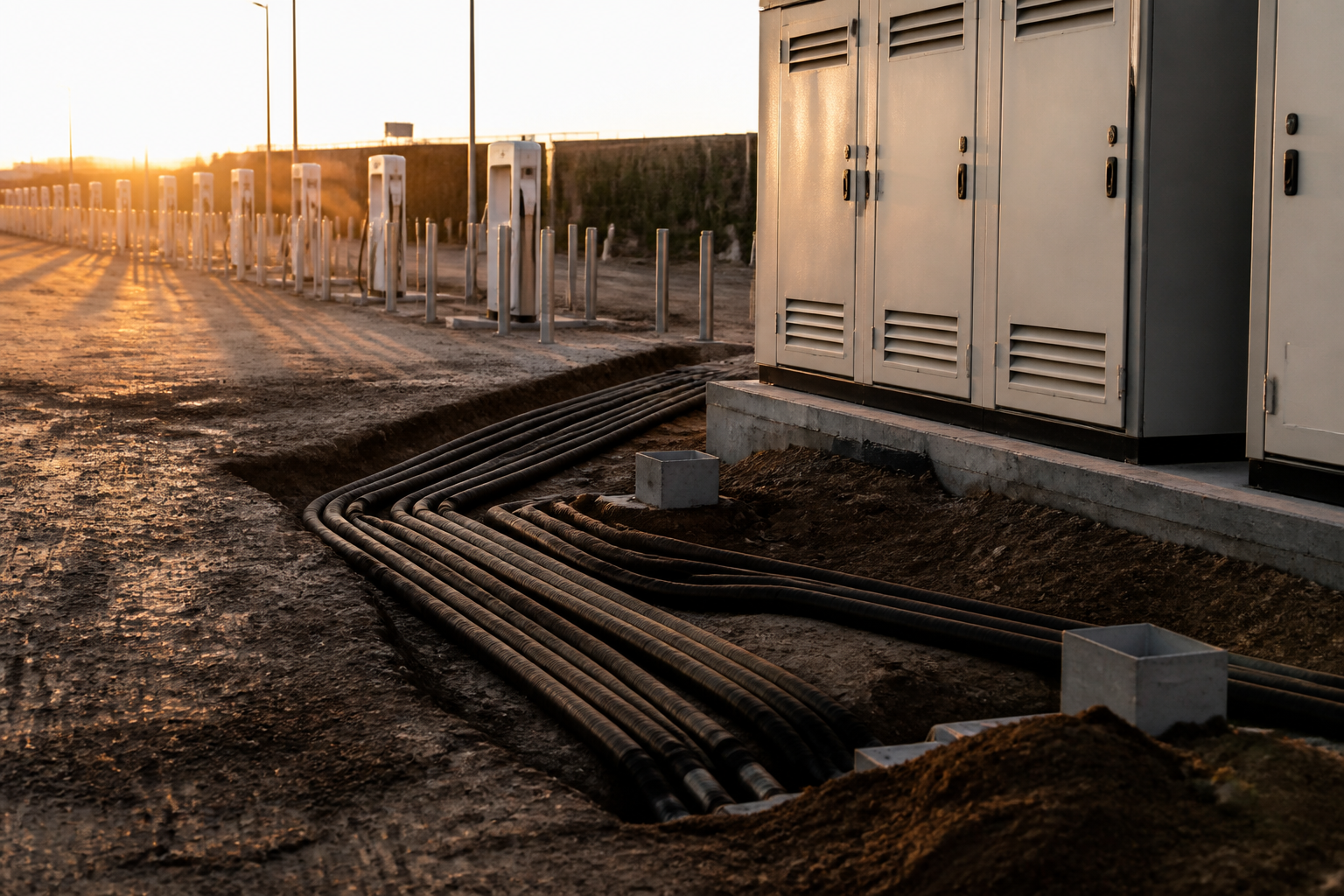
When businesses evaluate the move to electric, the focus usually falls on the vehicle list price. However, the true cost of infrastructure, including substations and cabling, can be vast. Infrastructure is not a plug and play exercise. It requires long-term planning that aligns with the wider energy strategy of the business. Finance teams must account for groundworks, which often involve site surveys, trenching for cabling, and potentially upgrading transformers to handle simultaneous charging loads.
Operating a fleet in a volatile energy market demands visibility. You are no longer just managing mileage logs and service records. You are managing a distributed energy resource. This requires a shift in how fleets report their environmental impact, especially with increasing regulatory scrutiny on carbon output. Organisations that fail to track energy usage at the charger level struggle to provide the audit trails required under modern carbon reporting standards.
Grid connection risks and capital allocation
The current process for upgrading site energy capacity is a significant undertaking. As reported in October 2026, many operators face extensive delays simply to access the power needed for high-output charging. These delays have a direct impact on the return on investment for new electric assets. For instance, if a fleet of electric vans is purchased but the depot power upgrade is delayed by two years, the business incurs operational costs for external charging that were not in the initial business case.
Finance teams should note that government support via the Depot Charging Scheme covers a portion of hardware costs, but the critical bottleneck often remains the electrical network connection itself. This reality forces a pragmatic approach to fleet scaling. Instead of aiming for a total site conversion, many companies now adopt hybrid models. This involves phased deployment, where initial electrification targets specific routes that can be supported by existing capacity before moving to infrastructure-heavy upgrades.
This hybrid approach often involves using existing site capacity for essential shifts while encouraging drivers to utilise home or public charging. Our work with The Electric Car Scheme assists in this by providing a framework that enables employees to charge efficiently at home, reducing the immediate burden on depot capacity. By shifting part of the charging demand to residential locations, firms can defer some of the capital requirements for high-output depot infrastructure.
| Factor | Risk Level | Planning Horizon |
|---|---|---|
| Grid Connection | High | 2-3 Years |
| Charger Hardware | Low | 3-6 Months |
| Carbon Reporting | Medium | Annual |
| Driver Training | Low | Immediate |
Risk levels are illustrative based on current market feedback regarding infrastructure lead times.
Carbon reporting as a financial metric
Carbon reporting is no longer a peripheral corporate social responsibility task. As of October 2026, the complexity of requirements means that finance departments are increasingly involved in data collection. Buyers and regulators expect clear, verified evidence of emissions reduction. This data is essential for maintaining Scope 3 emission targets, where supply chain partners now frequently require proof of decarbonisation from their delivery contractors.
When a business transitions its fleet, the data generated from new charging infrastructure becomes a vital audit trail. Every kilowatt hour measured at a charger contributes to the broader sustainability report. This transparency is essential for maintaining compliance with UK carbon rules. Without precise measurement, businesses risk greenwashing claims, as the actual emissions reduction of a fleet is entirely dependent on the energy source and consumption efficiency of the charging system.
Finance directors should view fleet energy data as a key asset. It provides the proof needed for internal and external stakeholders that the transition is delivering the promised carbon reductions. This shift toward high-fidelity data reporting aligns with wider UK climate policy, which increasingly demands accountability from commercial actors. Developing a robust data strategy early on avoids the need for manual, error-prone reconciliations of energy costs at year-end.
Every kilowatt hour measured at a charger contributes to the broader sustainability report.
Managing charging across a diverse fleet
The challenges of public versus private charging are significant for fleet managers. Relying on the public network exposes the business to variable pricing and inconsistent coverage. This is why private charging infrastructure remains the goal for many, despite the connection risks mentioned earlier. Private depots offer controlled costs and guaranteed availability, which are vital for maintaining tight delivery schedules in last-mile logistics.
For businesses without the capacity to build major depots, the focus often shifts to home charging solutions. Providing staff with the right tools ensures that fleets remain ready for the next shift without needing to stop at public hubs during working hours. This strategy also helps manage business mileage more effectively. By reimbursing staff for energy consumption at home, companies can gain visibility into real-world efficiency without the overhead of physical depot construction.
We often see that the most resilient fleets are those that balance their energy sourcing. They do not rely on one source of power. They use a combination of depot charging, public network access, and home solutions to maintain operational continuity. This diversification acts as an insurance policy against localised grid outages or sudden spikes in public charging costs.
Operational lessons from mass electrification
The broader market shows that early movers in fleet electrification are now dealing with maintenance and scaling. For example, recent industry activity in supporting electric bus fleets indicates that high-capacity charging is possible, but it requires significant technical coordination. With VEV supporting one in four UK electric buses, the sector has demonstrated that managed charging, where energy is throttled during peak hours, is necessary to prevent site energy costs from spiralling. Learning from these larger deployments can provide insights for smaller commercial fleets.
The lesson for an average finance director is that success lies in the details of the site integration. It is not enough to install hardware. The system must be capable of managing load balancing and integrating with existing site energy usage. A failure to plan for this can lead to massive energy costs during peak hours, potentially negating the savings gained from lower fuel costs. Finance teams should model the impact of charging on their overall site utility bills before committing to large-scale infrastructure.
For those planning their strategy, it is useful to review the steps outlined in our guide on practical steps for electric vehicle fleet adoption. Breaking the project into manageable phases ensures that capital is deployed only when the infrastructure is ready to support it. This phased approach allows the business to learn from each stage, optimising the software and load-balancing settings before scaling to the full fleet size.

| Phase | Activity | Key Stakeholder |
|---|---|---|
| Evaluation | Energy Audit | Finance |
| Planning | Grid Application | Operations |
| Execution | Hardware Rollout | Facilities |
| Review | Carbon Reporting | Compliance |
Recommended phased workflow to mitigate grid connection risk.
Looking ahead to 2027
The trajectory for the next year suggests that grid connection constraints will remain. Businesses should assume that delays will be a permanent part of the landscape for the medium term. This dictates a strategy focused on resilience rather than speed. Leaders should engage with Distribution Network Operators (DNOs) at least 18 to 24 months before they anticipate needing full load capacity for their fleet.
Finance directors should ensure their salary sacrifice and benefit budgets reflect these realities. If an infrastructure project is delayed, consider how other parts of the benefit scheme can take the strain, such as temporary support for staff using public charging infrastructure or flexible working policies for drivers. This flexibility is a hallmark of a robust electrification strategy that protects both the company and its employees from service interruptions.
We are seeing a trend towards more integrated energy management. Systems are becoming smarter, allowing for better monitoring of costs and carbon footprint. Businesses that embrace this technology early will find themselves better placed to report on their progress and manage their energy overheads effectively. The future of fleet management is not just in vehicle maintenance, but in energy procurement and the intelligent distribution of power across a dispersed fleet.
Questions people ask
- How long should I expect for a new grid connection for my depot?
- Current industry data suggests that grid connection queues can last up to 36 months in some UK regions. Businesses should initiate formal discussions with their local Distribution Network Operator early in the planning process to assess local capacity and potential upgrade timelines before committing to any fleet acquisition contracts.
- Are there financial risks to my fleet transition if infrastructure is delayed?
- Yes. Delays to grid upgrades often force fleets to rely on expensive public charging, which disrupts budget forecasts. Furthermore, failing to implement infrastructure as planned can lead to missed operational targets and inefficient vehicle utilisation. It is essential to synchronise procurement of vehicles with confirmed energy infrastructure delivery dates to protect project ROI.
- How do I include fleet carbon emissions in my mandatory reporting?
- Carbon reporting requires precise data on energy consumption, usually tracked at the charger level. By integrating smart charging hardware, businesses can record kilowatt hours used. This data serves as an audit trail for emissions reductions, which is increasingly expected by regulators and business partners to satisfy Scope 3 emission reporting requirements.
- What is the benefit of a hybrid charging approach?
- A hybrid model combines depot charging with home or public charging. This reduces the immediate capital burden on a business to upgrade site power for every vehicle. By enabling home charging, companies distribute energy load and lower the peak capacity required at their main site, while maintaining fleet flexibility.
- Does the government provide support for the electrical infrastructure at my site?
- Government support, such as the Depot Charging Scheme, can assist with specific hardware costs. However, this does not cover the entirety of site upgrade costs, such as substations and cabling. Businesses must still account for significant internal investment to ensure the site's electrical network can handle the increased demand of a commercial fleet.
Keep reading

electric vehicle market analysis
Analysing UK electric vehicle adoption numbers

electric vehicle adoption guide
Steps to choosing an electric car for personal use

electric vehicle fleet policy
Impact of updated ZEV mandate targets on fleet planning

electricity grid capacity management
How DNOs manage residential grid capacity

electric vehicle fleet policy
Managing financial risks of electric car fleet transition

Employee financial wellbeing
Supporting employee financial resilience

Employee reward strategy design
Implementing salary sacrifice schemes

domestic heat pump technology
Debunking common myths about domestic heat pump heating

green installer workforce standards