


Grid infrastructure and storage
Choosing between grid energy and local storage
Comparing the financial and practical trade-offs of relying on the national grid versus investing in residential battery storage systems.
 Alison DavidsonHead of Finance
6 min readUpdated
What matters here
- Grid reliance offers simplicity but leaves households exposed to fluctuating price caps.
- Home battery systems provide energy independence but require significant upfront capital expenditure.
- The decision hinges on individual usage patterns and the long term cost of grid connectivity.
In short
The decision to rely on the grid or install storage depends on your usage profile. Grid reliance provides immediate access without capital costs, while battery storage offers long term protection against peak time pricing. Evaluate your total consumption against the available capacity of your local network to determine if local generation and storage deliver a sufficient return on investment.
Choosing between these systems is a balancing act between operational simplicity and financial control. Homeowners must weigh the immediate availability of grid power against the logistical requirements of owning and maintaining energy hardware. This analysis provides the framework required to determine which path aligns with your household needs.
Evaluating the national grid connection
The national electricity grid serves as the primary provider for most UK households. Choosing to rely solely on this infrastructure avoids the necessity of installing complex domestic storage hardware. For many, this is the default state of energy consumption. The benefit is simplicity. You maintain an active link to a large, managed system that balances supply and demand across the country. This removes the need to monitor local generation levels or manage battery health.
However, this reliance comes with a dependency on retail energy prices. Even with price caps in place, market volatility remains a factor. When demand on the grid surges, the cost per kilowatt hour can increase, particularly during peak hours when the generation mix relies heavily on imported or gas-fired power. Relying on the grid means accepting that you are a price-taker rather than a manager of your own energy supply. You also remain vulnerable to local infrastructure constraints that might affect supply reliability during periods of high demand.
Furthermore, grid reliance places you at the mercy of standing charges and tariff structures dictated by energy suppliers. Without local generation, you are unable to offset the total cost of energy consumption. If your household is high-consuming, relying solely on the grid offers no mitigation strategy for rising annual bills, leaving you with little recourse other than energy efficiency measures to reduce your financial burden.
The case for domestic storage
Installing a home battery system introduces an alternative to pure grid dependence. By storing energy generated from solar panels or purchased during off-peak hours, you effectively buffer your home against market volatility. This shift is not just about environmental preference. It is an exercise in financial risk management. You trade a large upfront cost for lower, more predictable ongoing energy expenses.
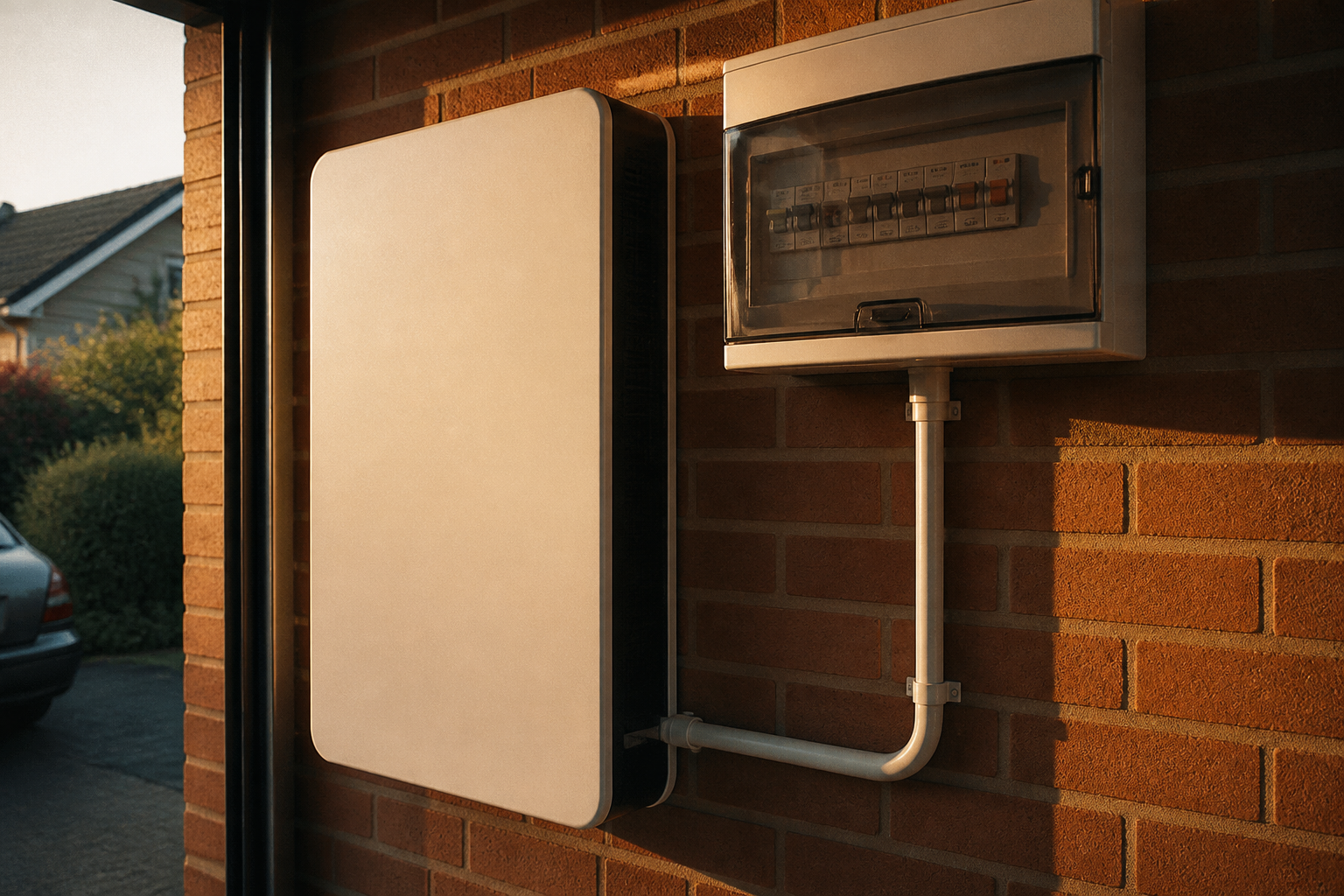
The trade-off is the capital requirement and the space needed for equipment. A battery system requires careful installation and integration with your existing consumer unit. You must also consider the cycle life of the battery. Over time, the capacity of the unit will degrade, meaning you will need to account for a replacement cycle that is not required when simply plugging into the wall. You also become responsible for the maintenance of that system.
Understanding how these components work together is vital. When you explore options through The Solar Scheme, the focus is often on how generation meets local demand. Adding storage expands this capacity, allowing you to bridge the gap between when power is produced and when it is actually needed by the household.
Crucially, storage units allow for time-shifting. By charging batteries when wholesale prices are low or using excess solar, households can avoid peak-time grid costs. However, you must carefully assess the round-trip efficiency of the battery. Energy is lost during both the conversion from AC to DC for storage and the subsequent inversion back to AC for household appliances. This loss must be accounted for in your financial modelling to ensure the system delivers a genuine net saving.
Comparing costs and capabilities
Financial analysis is the most reliable way to assess these two paths. You must calculate the cost of grid electricity over the next decade versus the amortised cost of a battery installation, including installation fees, maintenance, and potential replacement parts. Some households find that a hybrid approach—relying on the grid for base load while using storage to manage peak demand—is the most effective financial compromise.
The following table illustrates the main operational differences between relying on the grid and adopting an integrated storage solution.
For households considering their long term impact on energy consumption, the choice often comes down to the frequency of peak-time usage. If your household consumption is high during hours when grid prices are highest, the argument for storage strengthens. If your usage is relatively flat and low, the cost of the hardware may take significantly longer to recoup.
A typical financial model should account for inflation in retail energy prices, while also factoring in the potential for falling hardware costs in the secondary market. If you are also considering The Heat Pump Scheme, you must account for the increased total electricity demand of the home. A battery in this instance may be essential to avoid triggering expensive peak-time tariffs whenever the heating system initiates a cycle.
| Feature | Grid Only | Storage Setup |
|---|---|---|
| Upfront cost | Zero | High |
| Price volatility | High exposure | Low exposure |
| Maintenance | None | Annual checks |
| Supply source | National grid | Hybrid grid/local |
Figures are illustrative and assume a standard residential installation size.
Infrastructure and connection constraints
Local grid capacity acts as a hidden constraint for many homeowners. When you install significant solar capacity or high-capacity battery units, you may reach the limit of what your existing grid connection can support. In some parts of the UK, the local transformer may be constrained, requiring formal notification or even an upgrade from the Distribution Network Operator. This process is complex and can delay your project significantly.
When planning, you must assess whether your property can handle the expected export of power to the grid. If you are part of a The Net Zero Home Scheme initiative, these technical checks are part of the broader planning process. Ignoring these requirements can lead to hardware that cannot be fully utilised or, in extreme cases, a grid connection that trips during heavy load. It is a technical hurdle that requires professional oversight to ensure that your home does not overwhelm the local street network.
Homeowners should note that G98 or G99 compliance is a mandatory regulatory requirement for any inverter-based system. Failing to secure the necessary paperwork from the local Distribution Network Operator before commission can lead to forced disconnection. Always verify your fuse capacity, usually 60A or 80A, as adding high-draw appliances or high-speed battery chargers alongside legacy wiring can exceed the thermal limit of the service head.
Operational maintenance and lifetime
Every piece of equipment in an energy system has a lifespan. While grid cables are managed by utility companies, your home battery is your responsibility. Battery chemistry dictates that performance will decline after a certain number of charge cycles. This is a crucial, often overlooked, financial variable. You are essentially paying for the ability to shift energy consumption across time, and the price of that shift is the hardware's depreciation.
Pragmatic owners plan for this. They do not view a battery as a permanent fixture like a brick wall, but as a long-lived appliance like a boiler. You should anticipate that the financial modelling for your installation includes a replacement fund for the battery component at the 10 to 15-year mark. This ensures that when the time comes to swap the unit, the funding is already in place.
Maintenance is not merely financial. Inverter software updates are required periodically to ensure compatibility with modern grid balancing protocols. Failure to maintain the software environment of your home energy management system can lead to reduced efficiency or loss of smart-grid functionality. Treat this technology as a software-dependent asset rather than a passive mechanical component.
You are essentially paying for the ability to shift energy consumption across time, and the price of that shift is the hardware's depreciation.
Practical decision making
Choosing between these paths is a question of weighing risk. Do you prefer the risk of fluctuating energy prices provided by the grid, or the risk of hardware maintenance and capital expenditure involved in storage? There is no single correct answer that applies to every home. The geography of your home, your roof orientation, and your daily lifestyle all dictate the economics.
If you want to understand more about these options, you might look at our about page to learn about the frameworks we provide for assessing such investments. Often, the best approach is to start with a clear audit of your own energy usage. Look at your bills for the last twelve months. Identify your peak hours. Once you have a clear dataset, you can model how a battery might change those figures. This is the difference between making an emotional choice and making an informed financial one.
Consider your future energy plans as well. If you are transitioning to an electric vehicle, using The Electric Car Scheme, your battery storage system could serve as a secondary buffer, though many choose to prioritise direct vehicle-to-charger connectivity. Modelling your energy future requires a holistic view of your household load rather than assessing generation and storage in isolation.

Questions people ask
- Does installing a home battery remove my reliance on the national grid?
- No. Unless you opt for an expensive, complex off-grid configuration, your system will remain connected to the national grid. The battery serves as a storage buffer to manage demand and supply, but the grid remains necessary for periods of low generation and as a failsafe when your battery capacity is depleted.
- What happens if my battery storage system requires an upgrade from the Distribution Network Operator?
- If your proposed system exceeds the capacity of the local substation or street wiring, you must apply to the DNO for an upgrade. This can involve significant lead times and costs, potentially affecting the overall return on investment. Always confirm your local network capacity through a certified professional before committing to hardware purchase.
- How do I calculate the real cost of owning battery hardware over ten years?
- You should divide the total capital cost of the battery, installation, and associated wiring by its expected cycle life or useful life in years. Include an annual allowance for maintenance, software management, and the projected cost of replacement parts. Compare this amortised annual figure against the savings generated by shifting energy consumption away from peak tariffs.
- Are there tax or grant benefits for choosing domestic energy storage?
- Government support schemes change periodically and often depend on the wider context of your home efficiency. You should review our schemes to determine if your specific situation qualifies for incentives. It is important to distinguish between grants that provide upfront capital support and long-term tax advantages, as these significantly impact the payback period of your investment.
Keep reading

green installer workforce standards
Finding a reliable green technology installer

electricity grid capacity management
How DNOs manage residential grid capacity

domestic heat pump technology
Debunking common myths about domestic heat pump heating

electric vehicle fleet policy
Managing financial risks of electric car fleet transition

electric vehicle market analysis
Analysing UK electric vehicle adoption numbers

electric vehicle adoption guide
Steps to choosing an electric car for personal use

electric vehicle fleet policy
Impact of updated ZEV mandate targets on fleet planning

Employee financial wellbeing
Supporting employee financial resilience

Employee reward strategy design